
This article is written for: ✅ Zello Work ❌ Zello Friends & Family.
Bridge connects traditional two-way radios with Zello’s powerful push-to-talk (PTT) solution, enabling seamless cross-platform communication so teams can use both the hardware and software that’s optimized for their unique operational environment.
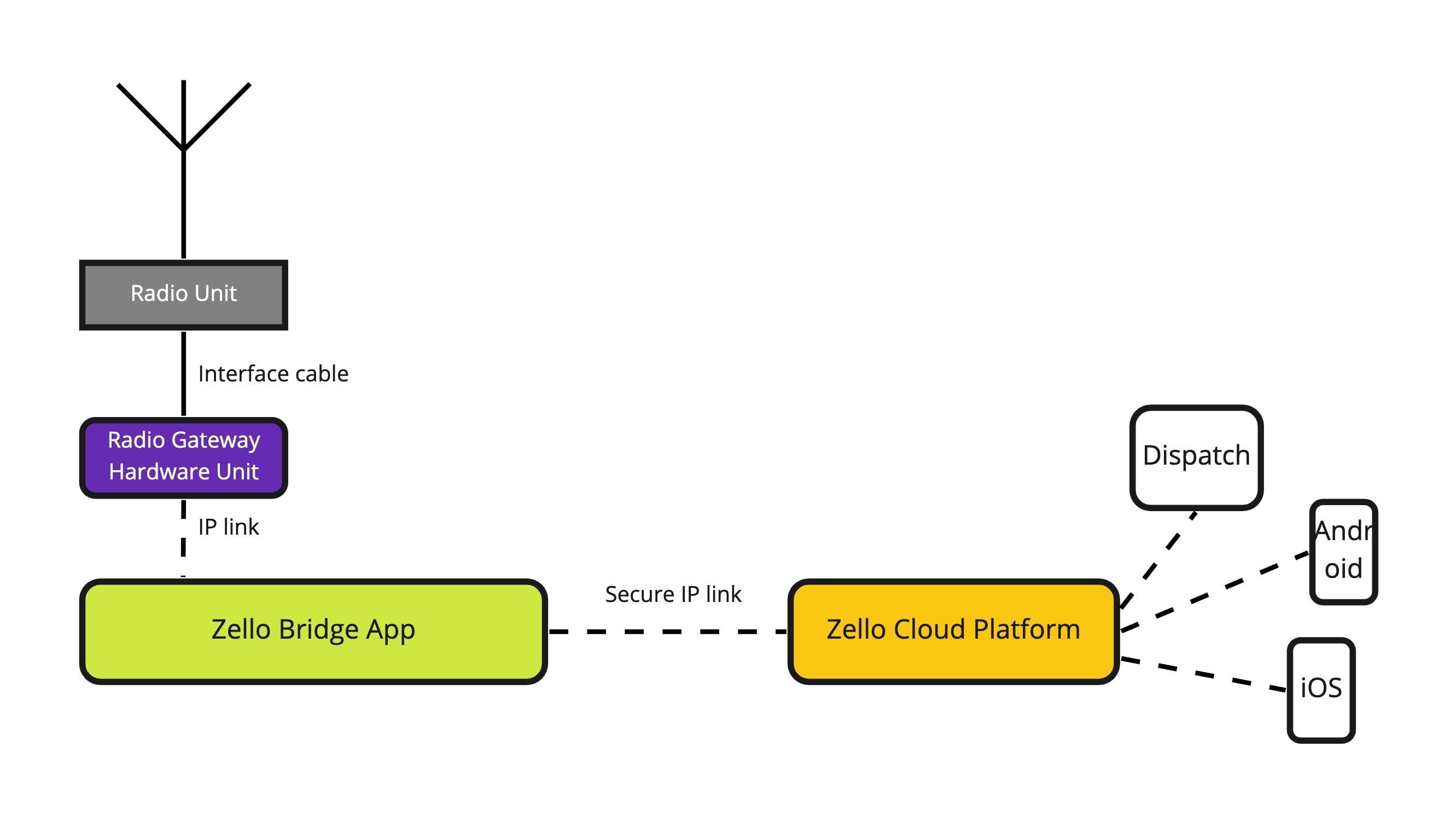
Bridge runs quietly in the background, ensuring non-disruptive interoperability between radio users and Zello. Its latest release expands capability to include both USB and JPS gateways, as well as provides an updated management UI for more friendly and accessible usage.
Networks that have historically utilized Zello’s legacy PC app will find Bridge a vital tool in their communications ecosystem. Zello plans to sunset the legacy PC app in the near future, so we highly recommend migrating to Bridge as soon as possible to ensure you’re receiving the best support and most updated product.
Compatibility
This application is compatible with USB and JPS gateways. While both gateway types connect radios with communications software, they differ in how they transmit audio; USB gateways require direct USB connection to a PC, whereas JPS gateways generally transmit messages using Radio Over IP (RoIP) technology, meaning audio is delivered via an internet connection.
Common models of these gateways include:
Please note that while above-listed JPS gateways require utilization of Zello Bridge, newer JPS gateway models include updated firmware that enables connection via the JPS management interface.
For example, JPS gateways like the ACU-Z1 and RSP-Z2 already have the Zello Chanel API integrated. While they’re compatible with Bridge, they don’t require it. See this JPS documentation for more information.
Bridge is only compatible with channel communications. Because it relies on Zello’s channel API, it can’t be used for 1:1 messages. It’s currently exclusively available in a x64 bit package.
How it Works
Bridge expands Zello’s functionality beyond traditional Android and iOS operating systems, allowing devices operating on proprietary firmware to integrate with the Zello infrastructure.
When configured with either a JPS or USB gateway, Bridge connects two-way radios with Zello, enabling smoother, more tailored PTT communications. It reads a 2-level structure from the configuration file: links and connectors.
- Links share the audio streams between connectors. They’re what ensure communications are transmitted from one connector to the other (i.e. from Zello to your team’s radios).
While links are dependent on their designated connectors, they don’t interact with other links. Each link will have at least two connectors—the Zello API, the JPS gateway, or the USB gateway —and additional, platform-specific configuration attributes that dictate Bridge’s configuration.
Bridge easily supports up to 16 links.
- Connectors are the endpoints you’re connecting using Bridge—for example, Zello’s channel API and a USB gateway. There are three possible endpoints: the Zello channel API, a USB gateway, or a JPS gateway. Each link includes at least two connectors; connectors are required attributes of a link's configuration.
Status Page
One of Bridge’s strengths lies in your ability to monitor its status through a webpage, providing access to real-time updates on your system’s performance. Once you’ve configured your links, their status will be displayed on the dashboard, offering targeted insight into the operations of each of your links and their associated connectors.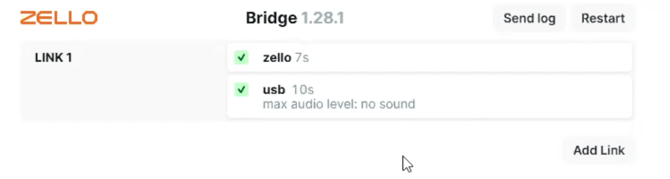
The status page is configured under the REST server section of the configuration file. It's accessible through port :8810.
Setup
In this article, we'll walk through configuring your instance of Zello Bridge. Additionally, we'll provide context for errors you may receive when using Bridge. If you have questions at any point in this process, please don't hesitate to contact our team at [email protected].
Please note: Zello communicates on multiple domains and subdomains—including zellowork.io. If you experience connectivity issues, consider allowing access by domain name. Please contact our team for a full list of available domains/subdomains.
Step 1: Install Bridge
- Click this link to download Bridge's installation package (version 1.28.1).
- Run the installation package on your computer. Once installed, Bridge will automatically launch.
- Open your browser of choice and type 127.0.0.1:8810 in the address bar. This will take you to Bridge's status page, which indicates a successful installation.
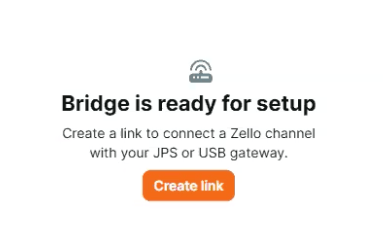
Step 2: Configure the Zello Connector
Use the convenient user interface to easily and quickly configure Bridge
The first setup form establishes the link and the first connector that connects to your gateway user.
- click create link
- Fill in the empty fields with the relevant information
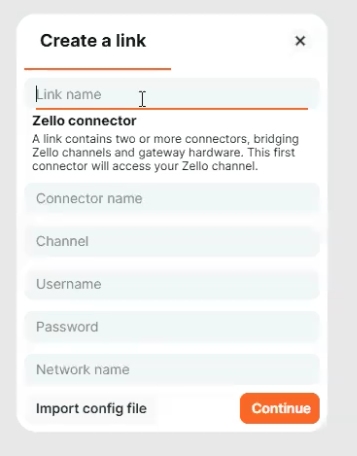
| Parameter | What is it? | Example Value |
|
Link name |
The name of link | Link #1 |
| Connector Name |
The connector’s name |
Zello connector |
| Channel |
The name of your channel you’d like to connect to the gateway. Please note that the channel must be pre-existing by this step. For information on creating channels, see this article. |
Radio Channel |
| Username |
Username of an existing user profile. See this page for assistance creating a new user. This username should be created specifically for the link you’re setting up. Please note that the username cannot be in use on another device or in another Zello Bridge link. It should be created for a single, specific link. Ensure this user has been added to the channel you’ve assigned in the attribute above. |
Gateway User |
| Password | The password associated with the username provided above. | mypassword1234! |
| Network Name | Your ZelloWork Network name | mynetwork |
Step 3: Configure the gateway connector
The second setup form configures the gateway connector
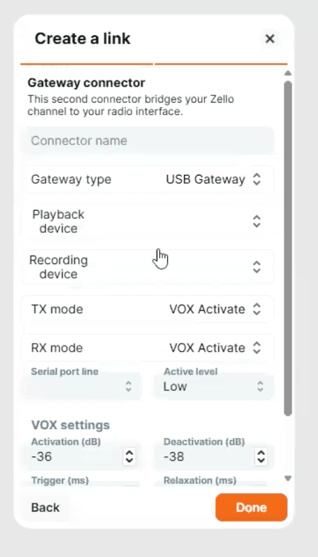 Create a link
| Parameter | What is it? | Example Value |
| Connector Name | The connector’s name | gateway connector |
| Gateway Type | The type of gateway | USB Gateway or JPS Gateway |
| Playback Device | The selected speaker that will play the transmissions being received over the network. This is auto-populate from your computer's sound settings. | Speakers (2 - USB device) |
| Recording Device | The selected microphone that will record transmissions being sent over the network. This is auto-populate from your computer's sound settings. | Microphone (2-USB device) |
| TX Mode | Transmission Mode |
If you're using VOX on Zello Bridge, select VOX Activated. If you're using a USB gateway, select USB Serial Port |
| * Serial Port (If using USB Serial Port) |
The operating system-assigned name of the connected gateway’s serial port. The serial port name can be found in your Device Manager. utilizes the serial port line state to start and stop TX message transmission (to radio).
|
COM3 |
| *Serial Port Line (If using UBS Serial Port) |
RTS is the most common value This field is dependent on the gateway in use. Please refer to your gateway’s manual for more information.
|
RTS or DTS
|
| Activate Level |
This field is dependent on the gateway in use. Refer to your gateway’s manual for more information. [what does this parameter do?] |
high or low |
| RX Mode | Receiving Mode | If you're using VOX or a USB serial port on Zello Bridge, select VOX activated. [when to select USB Serial port?] |
| Serial Port Line | The operating system-assigned name of the connected gateway’s serial port. The serial port name can be found in your Device Manager. utilizes the serial port line state to start and stop RX message transmission (From radio) | Leave blank if using VOX activation |
| Active level | what does this do? | high or low |
VOX Settings
| Parameter | What is it? | Example Value |
| Activation (dB) |
The sound level at which Bridge will activate transmission. The accepted values range from -80db (lowest) to 0db (highest). |
-35 |
| Deactivation (dB) |
The sound level at which transmission is deactivated. This cannot be set higher than the activation threshold, and it’s best to set it between 3 and 5db lower. |
-37 |
| Trigger (ms) |
The amount of time (in milliseconds) VOX takes to start transmission. Increasing the trigger time will help eliminate false transmissions caused by short impulses. |
200 |
| Relaxation (ms) |
The amount of time (in milliseconds) the gateway waits between transmission of two messages. This setting helps prevent overlapping messages. Only applicable to VOX messages. |
700 |
| Pause time (ms) |
The length in milliseconds of a loud, single-tone signal Bridge inserts before every VOX message. This ensures the radio recognizes the new transmission. Best set to 0 |
0 |
*Please note that JPS gateways require additional setup in the JPS management interface. See the Additional Information for JPS Gateways section below
Additional Information for JPS Gateways
Once you've created your Bridge configuration file, you'll also want to add a connection profile matching JPS RoIP connector configurations in your JPS radio gateway management interface. For detailed instructions about configuring JPS radio gateway hardware, please refer to your JPS product documentation.
Configuration Demo Video
Coming soon.
Troubleshooting
You may encounter a variety of errors when setting up your Bridge environment. The table below lists the possible error codes and their meanings. If you run into trouble resolving these errors, don’t hesitate to contact our team for tailored assistance.
Error Codes
|
Code |
Meaning |
How to solve it? |
|
1001 |
Connector is not ready to process the incoming audio |
Make sure incoming audio is not split into series of ultra short messages |
|
1002 |
Linked connector has failed to process the audio |
The problem is related with another (linked) connector |
|
1003 |
Still sending previous message |
Make sure incoming audio is not split into series of ultra short messages |
|
1004 |
Receiving another message |
Check if full-duplex mode is supported for all connectors in the link. If not (ie Zello channel does not support sending and receiving at the same time) – turn off full-duplex mode |
|
1005 |
Unable to send outgoing audio |
It could be network connectivity problem, or jitter buffer too small (Bridge has nothing to send) |
|
2001 |
Failed to resolve JPS gateway address |
Check remote_ip and remote_port configuration values |
|
2002 |
Failed to resolve host address |
Check local_ip and local_port configuration values |
|
2003 |
Gateway connect failed |
Check gateway endpoint is accessible from the Bridge host / specified local endpoint |
|
2004 |
JPS Gateway offline |
Connectivity issue or JPS hardware problem |
|
2005 |
Read bad packet |
MITM or proxy corrupts payload or anyone other connectivity issue |
|
2006 |
Read bad audio packet |
Could be unsupported codec or payload corruption |
|
2007 |
Received bad audio packet |
Other connector transmits unsupported audio format |
|
2008 |
Read audio timeout |
JPS Gateway does not send audio packets with expected speed, check JPS device settings |
|
2009 |
Read buffer starving |
JPS stopped sending audio packets for a while, larger jitter_buffer_size config value may resolve the problem |
|
2010 |
Send buffer starving |
Other connector stopped sending audio packets for a while, larger jitter_buffer_size config value may resolve the problem |
|
2011 |
Send keepalive failed |
Problem with sending message(s) to JPS Gateway |
|
2012 |
Send timeout |
Other connector unexpectedly stopped transmitting audio for a long time, outgoing message to JPS will be finished gracefully |
|
3001 |
Not connected |
Unable to initiate connection to Zello network, “channel_api_url” could be invalid Also this code registered if other connector tries to send audio to the not connected Zello connector |
|
3002 |
Invalid Zello credentials
|
Make sure that the username, password and network in Zello connector configuration in zellobridge.json file are entered correctly, save the changes, and restart Zello Bridge Could be the connectivity problem either |
|
3003 |
Channel offline |
Connectivity problem or someone disconnected Bridge zello user from the configured zello channel. Not an issue if channel reconnect happened within seconds |
|
3004 |
Opus encoder failed |
Bridge failed to create opus packet, might be a problem with audio received from the other connector |
|
3005 |
Opus decoder failed |
Invalid opus packet received from Zello connection: MITM or proxy corrupts data, or anyone other connectivity issue |
|
3006 |
Start stream failed |
Unable to start outgoing message; if this happens often, Bridge zello account might be granted extra channel priority |
|
3007 |
Stop stream failed |
Most likely current message already interrupted by any other zello channel user, not an issue in this case |
|
3008 |
Error received |
Bridge received some error from channel api, should be some additional context |
|
3009 |
Kicked |
Some other Zello client device signed in with credentials used by this Bridge connector |
|
3010 |
need a pause before starting a new stream |
Set pause time (ms) to 0 Set stream guard timeout (ms) to 0 |
|
4001 |
Audio device not connected |
Connect USB audio device or check audio device names in the OS |
|
4002 |
Serial port not connected |
Connect usb/serial device or check existing serial ports in the OS |
|
4003 |
Audio device failed |
Check audio device driver update |
|
4004 |
Serial port failed |
Reconnect / restart the device that provides serial port |
|
4005 |
Port audio library failure |
Check audio device driver update |
|
4006 |
Audio recording overflow |
Some recorded audio samples have been dropped, check host device performance / audio device driver update, could be deadlocks in the Bridge src |
|
4007 |
Audio recording underflow |
Some samples have not been recorded, a chunk of silence provided to the Bridge. Check audio device driver update, could be deadlocks in the Bridge src |
|
4008 |
Recording buffer full |
Identical to 4006, deadlock/bottleneck during the post-processing of the recorded audio by bridge itself. Host device performance may also trigger this error, though it is highly unlikely |
|
4009 |
Resampling failure |
Check logs for possible clues |
Send a Log to the Zello Team
Logs provide additional context for the error codes you’re receiving. If you find yourself unable to resolve an issue, submit a log through the Bridge interface, then email us at [email protected] for assistance.
To send a log from Zello Bridge:
- 1. From the Bridge interface, click Send log. Enter your email and describe the issue you’re experiencing. Then click Send to Zello.
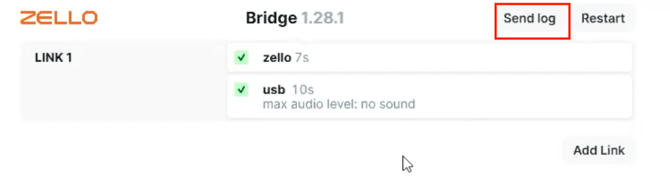
- Email [email protected]. Let our team know you’ve recently submitted a log, and provide any additional context you think will aid the troubleshooting process.
Please note that we don’t monitor log submission, so it’s important that you email our team notifying us that you’ve sent a log. Additionally, it’s important that you send a log quickly after you’ve encountered an issue.
Using VOX on Zello Bridge
Zello Bridge also supports sharing audio without a gateway device using VOX.
- With a traditional two way radio, you can share audio from your radios into Zello one way.
- With a VOX enabled radio, you can share audio to and from Zello two ways.
Requirements for using VOX with your radios:
-
A USB soundcard
-
Cables that connect from your radio’s microphone and speaker jacks to your sound card, functioning as a microphone and speaker input/output
Configuration
You will need to set your TX Mode and RX Mode in step 3 to VOX Mode
When using external hardware like a USB soundcard, the playback device and recording device values in your setup form should reference the USB soundcard.
Please note: You do not need Radios to use VOX on Bridge. However, you must ensure that the playback device and recoding device values match the audio source you intend to use, as configured in your Windows sound settings.